
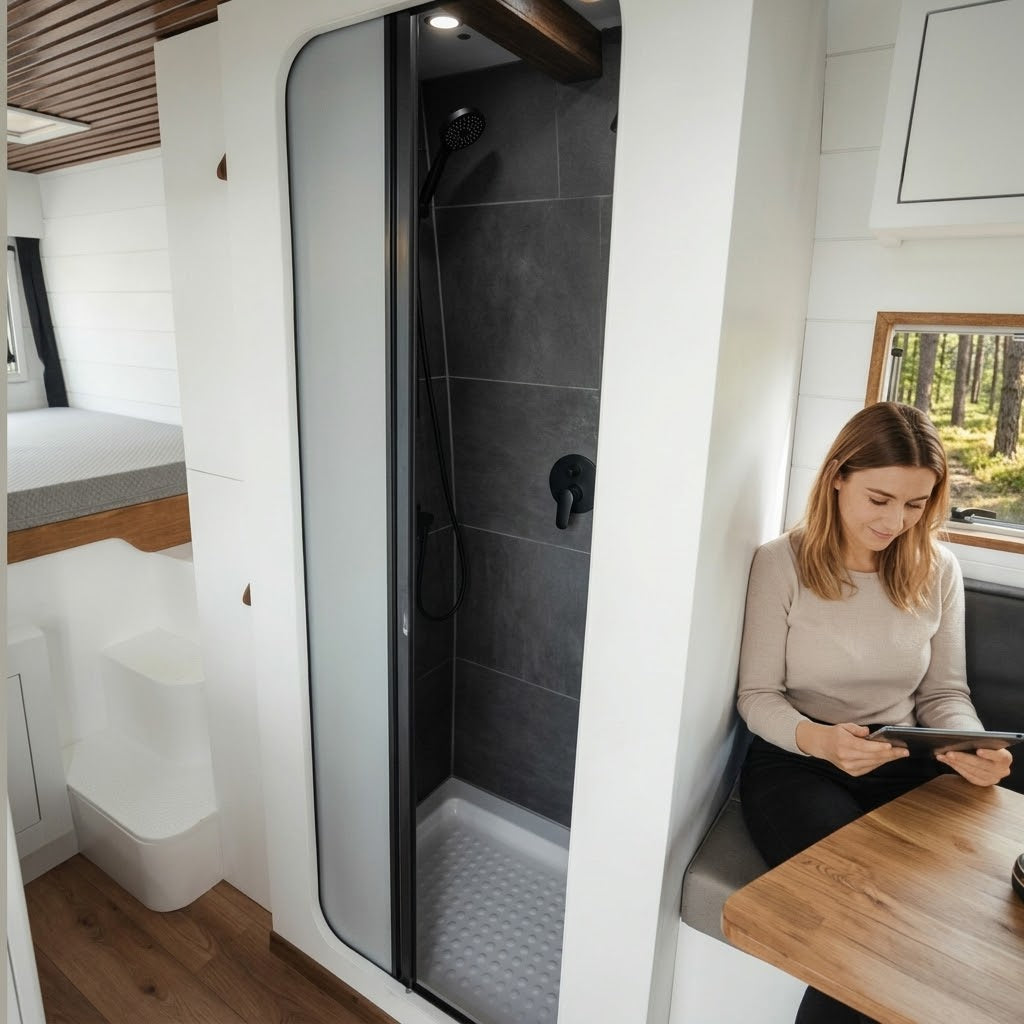
New Zealand has to be one of the best places on earth to explore in a campervan. Lakes, glaciers, black-sand beaches and empty roads – it's no wonder so many of our customers dream of a trip there, and plenty of Kiwis build and buy from us too. But if you're planning to freedom camp in Aotearoa, the rules have changed, and they've changed in a way that puts the humble van bathroom right at the centre of things.
Here at THEdoûr Bespoke we spend our days helping people fit toilets, showers and doors into very small spaces, so we've been watching the New Zealand self-contained campervan rules closely. Here's a plain-English look at what's new, why the toilet matters so much, and how to plan a compact bathroom that works in real life.
What changed: from blue warrant to green warrant
New Zealand's Self-contained Motor Vehicles Legislation Act 2023 overhauled the way vans are certified for freedom camping on council land. The old blue warrant (based on the NZS 5465 standard) is being replaced by a new green warrant, with a national register of certified vehicles and the Plumbers, Gasfitters and Drainlayers Board acting as regulator.
The key dates, according to New Zealand's Ministry of Business, Innovation and Employment (MBIE) and local councils:
- 7 December 2024 – rental campervans needed a green warrant to count as self-contained.
- 7 June 2026 – the transition period for privately owned vehicles ended, and blue warrants are no longer valid for freedom camping on council land.
- A green warrant is valid for four years.
- The freedom camping infringement fee rose from NZ$200 to NZ$400.
In other words, if you're heading to New Zealand this coming summer season, the green warrant is now the one that counts.
Why the toilet is now the big deal
The headline change for van builders is simple: a portable toilet no longer qualifies. Under the green warrant, the toilet must be fixed in the vehicle and installed to the manufacturer's specifications. The New Zealand Motor Caravan Association (NZMCA) summarises the minimums like this:
- Fresh water: 4 litres per person per day, with a minimum of 12 litres per person.
- Grey/waste water: 4 litres per person per day, minimum 12 litres – and if the tank is smaller than the fresh tank, it must be vented and monitored.
- Cassette toilet: at least 1 litre per person per day, with a minimum net holding capacity of 3 litres per person.
- Plus a sink, rubbish storage and, where a composting toilet is fitted, ventilation.
That "fixed toilet" line is the one that sends van owners back to the drawing board. A cassette toilet that used to live in a cupboard and come out at night now needs a permanent home – and in a van, a permanent home for a toilet usually means a little wet room or toilet cubicle with a door.
Please note: the rules and their interpretation are set and updated by the New Zealand authorities. Always check the latest guidance from MBIE and the Plumbers, Gasfitters and Drainlayers Board, and speak to a certifier, before you build or travel.
The real-world problem: fitting a fixed toilet in a small van
We hear the same challenges from van builders all over the world, and they're even more pressing once a fixed toilet becomes compulsory:
1. A swing door eats your floor space
A hinged door needs a clear arc to open. In a narrow van that arc often blocks the kitchen, the bed or the aisle – and sometimes it simply won't fit at all.
2. Curtains don't feel private (or stay dry)
A shower curtain is cheap, but it clings, drips and rarely gives you real privacy when there are two or more of you in a small space.
3. Glass is heavy and fragile on the road
New Zealand's roads are famously twisty, with plenty of gravel. Heavy glass doors and rattling fittings aren't what you want bouncing around behind you.
4. Odd-shaped openings
Van walls curve, wheel arches get in the way and no two conversions are the same. A standard-size door rarely fits a non-standard space.
How THEdoûr products help
This is exactly the kind of problem our Home on Wheels range was designed for. Our doors are built for life on the move, with zero-glass options throughout, and we ship worldwide from our base in Pembrokeshire, Wales – including to New Zealand.
- ROLdoûr retractable shower door – retracts neatly to the side, so there's no swing arc at all. The Bespoke version is made to measure from 500–1000mm wide and up to 2000mm tall, in 10 frame colours, with standard or DualShield fabric. There's also a Pre-Made option, plus the all-black Noir and all-white Blanc.
- TAMdoûr tambour sliding door – a sliding door on a flexible track that can run straight, round a 90° corner or along a curve, ideal for following a curved van wall around a toilet cubicle.
- FOLdoûr and FLEXdoûr – zero-glass folding doors. FOLdoûr is a bi-fold acrylic door in black or white with a magnetic close that folds left or right; FLEXdoûr is a PVC folding door made in Italy, 1850mm tall with a reducible width.
- ZIPdoûr – our lightest and most affordable option, an insulated zip-close door that's perfect for 4x4 and overland builds where every kilo counts.
Not sure which suits your layout? Our campervan shower door range compares them side by side, and our free Size My Door tool helps you work out what will fit.
Planning a practical van bathroom: our tips
- Design around the toilet first. Choose your fixed toilet, then plan the cubicle and door around it, not the other way round.
- Check you can actually use it. Sit on it with the door closed. If your knees or elbows hit the walls, rethink the layout.
- Think about the door last thing at night. With the bed made up, can you still get in and close the door? A retractable or sliding door often makes the difference.
- Keep it light. Every kilo matters on long, hilly drives – zero-glass doors help.
- Measure twice. Van walls are rarely square, so measure at the top, middle and bottom. Our support guides walk you through it.
Frequently asked questions
Can I still use a portable toilet to freedom camp in New Zealand?
Not for a green warrant. Under the new rules, vehicles with a portable toilet can no longer be certified as self-contained, so the toilet needs to be fixed. Some campsites still welcome non-self-contained vehicles, so check each site's rules.
Is my old blue warrant still valid?
For freedom camping on council land, blue warrants stopped being valid on 7 June 2026. Some private and NZMCA sites have their own rules, so check before you stay.
Does THEdoûr ship to New Zealand?
Yes – we're worldwide specialists and ship from the UK to customers all over the world. Get in touch for delivery details to your area.
Which door is best around a fixed toilet in a small van?
If space is really tight, a ROLdoûr retractable door is usually the most space-efficient because it has no swing arc. If you have a curved wall, TAMdoûr's flexible track is a great fit. For a budget-friendly or ultra-light build, look at ZIPdoûr.
Do your doors help with certification?
Certification is carried out by authorised certifiers in New Zealand against the official requirements, and the door itself isn't one of the listed requirements. What a good door does is make a fixed-toilet layout practical, private and comfortable to live with.
Ready to plan your van bathroom?
Whether you're building a van for New Zealand's Southern Alps or the Scottish Highlands, a fixed toilet and a small wet room don't have to take over your build. Explore our Campervan & RV range, or contact our family team with your measurements and a photo – we'll happily help you find the right door for your space.
– Rhys Tomlin, THEdoûr Bespoke
Share:
Small Space, Big Impact: ROLdoûr on George Clarke's Amazing Spaces: First Home
Wintering in Spain and Portugal in Your Campervan: Mosquitoes, Heat and Privacy