
If you have ever walked along the canals in Amsterdam, you will know the feeling: rows of tall, skinny houses leaning on each other like old friends, huge windows, and a hook sticking out at the very top of every gable. I love them. As a small family business that spends its days helping people squeeze more out of small spaces, those houses feel like a masterclass in living narrow.
Plenty of us in the UK live narrow too – Victorian terraces, Georgian townhouses, converted mews houses and city flats with one long corridor. So this week I wanted to look at what Amsterdam's canal houses can teach us, and share some practical space-saving ideas for narrow houses that work just as well in Cardiff, Bristol or Leeds as they do on the Herengracht.
Why Amsterdam's houses are so narrow
The story most locals tell is that, from around the 16th century, Dutch citizens were taxed on all sorts of things – including the width of their houses. Builders responded by going narrow at the front and very deep at the back, then stacking floors upwards. Space along the canals was precious, too, so every metre of frontage counted.
Some of the results are remarkable. Oude Hoogstraat 22 is often listed as one of the narrowest houses in the city at around 2.2 metres wide, and Kloveniersburgwal 26 – the "little Trippenhuis" – is about 2.4 metres. The rear façade of Singel 7 is just over a metre, although the house is wider at the front.
The clever bits that came with living narrow
- Steep, tight staircases. A narrow, tall house needs a staircase that is just as thin and steep – which is why Dutch stairs have such a reputation.
- Hoist beams and big windows. Because furniture wouldn't fit up those stairs, it was hoisted up the outside of the house on the hook at the top and brought in through the windows. That's one reason Dutch windows tend to be so large.
- A deliberate forward lean. Many façades lean slightly forward on purpose, so goods being hoisted didn't bash into the front of the house. (The sideways leaning is a different story – that's down to wooden foundation piles in soft, wet ground.)
- Deep floor plans. With so little width, rooms run front to back, often with a long corridor or a stair core in the middle.
The problems of a narrow home (in any country)
Whether it's a canal house or a two-up two-down, narrow homes tend to share the same headaches:
- Doors that fight each other. In a slim hallway or landing, a swinging door can block another door, the stairs or a radiator.
- Tiny bathrooms. Bathrooms are often squeezed into the back of the house or under the eaves, where a hinged glass shower door has nowhere to swing.
- Big windows, little privacy. Tall windows bring in lovely light, but in a street of close-packed houses you can feel very on show – and lose a lot of heat on a winter's night.
- Light at the wrong time. Street lamps and early summer sunrises are hard to block out in a bedroom with a tall sash window.
What the Dutch do with their windows
The Netherlands is famous for its open curtains. You'll often hear it linked to the country's Calvinist past and a "nothing to hide" attitude, and in Amsterdam the large windows and close-packed streets make homes very visible from outside. In reality, plenty of Dutch homes do have curtains or blinds – they're opened in the day for daylight and closed at night for privacy and warmth.
I think that's the sensible middle ground for any narrow home: let the light flood in during the day, then close up properly at night. Many UK councils' energy advice includes closing curtains and blinds at dusk to help keep the heat in, and it costs nothing to do.
Space-saving ideas for narrow houses
1. Swap swing doors for retractable or sliding doors
Every hinged door needs a clear arc of floor to open into – space you can't use for anything else. In a narrow hallway, en-suite or under-stairs cupboard, a door that rolls or slides out of the way gives you that floor back and stops doors clashing.
2. Rethink the small bathroom
If your bathroom is tucked into the back of the house or the loft, a folding or retractable shower door means you're not fighting a glass panel every time you step in. Zero-glass doors also mean there's no glass panel to worry about if you have children or older relatives at home.
3. Use the height you've got
Narrow houses are usually tall houses. Put storage up high, run shelving to the ceiling and use sliding or tambour doors on tall cupboards so they don't stick out into the room when open.
4. Dress big windows for day and night
Choose blinds that let you control light and privacy rather than just "open" or "shut". A blind that can sit partly down, or combine a net with a blackout layer, suits a tall street-facing window far better than a heavy curtain that takes up space.
5. Keep the back door open – without the bugs
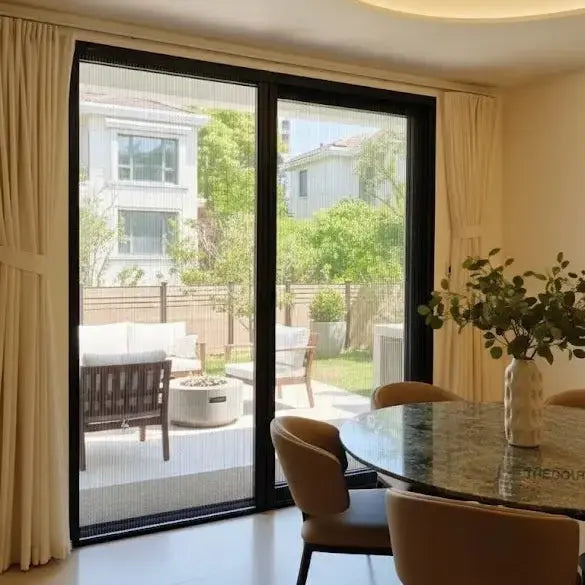
Narrow houses often have one door at the back to the garden or yard. A door screen lets you leave it open for air on warm days without letting flies and moths in, and without a bulky frame or track to trip over.
How THEdoûr products help in a narrow home
Living narrow is exactly what our range was designed for – whether it's a campervan, a tiny home or a slim townhouse.
- Space-saving doors: Our ROLdoûr retractable and TAMdoûr sliding doors roll or slide out of the way, so they work in hallways, en-suites, utility rooms and tall cupboards where a swing door just won't fit.
- Shower and bath doors for small bathrooms: The FLEXdoûr and FOLdoûr zero-glass folding doors fold neatly away, so a cramped loft or back-of-house bathroom feels bigger.
- Window blinds for tall windows: The WINdoûr insulated honeycomb blackout blind and net (Single or DUO) and the ROLdoûr Slimline give you privacy, blackout and an extra insulating layer at night, made to measure for your window.
- Door screens for the back door: NETdoûr and BLINDdoûr trackless door screens are made to measure from 1500–2000mm high and 600–2000mm wide, with a low-profile floor guide – a pleated net to keep insects out, or an insulated blackout version for privacy.
Not sure of your sizes? Our free Size My Door and Measure My Blind tools walk you through it, and our support guides cover fitting step by step.
Frequently asked questions
What is the best door for a narrow hallway?
A door that doesn't swing. Retractable and sliding doors open within their own frame or track, so they don't block the hallway, the stairs or another door. They're ideal for en-suites, cupboards and utility rooms off a narrow corridor.
How can I make a small bathroom in a narrow house feel bigger?
Remove anything that swings into the room. A folding or retractable shower door, wall-mounted storage and a light colour scheme all help. Zero-glass folding doors such as FLEXdoûr and FOLdoûr fold away when you don't need them.
Are insulated blinds worth it for tall windows?
Big windows are lovely for light but can lose a lot of warmth at night. A honeycomb blind traps a layer of air against the glass, so closing it at dusk adds an extra barrier – and gives you privacy and blackout at the same time.
Do THEdoûr ship outside the UK?
Yes. We're based in Pembrokeshire, Wales, and ship worldwide – so whether you live in a Dutch canal house or a London terrace, we can help.
Make your narrow home work harder
Amsterdam's canal houses have proved for centuries that a narrow home can be a brilliant home – you just have to be clever with doors, stairs and windows. If you'd like help choosing the right door, blind or net for your space, have a look at our Home & Office range or get in touch with our team. We're a small family business and we're always happy to help.
– Rhys Tomlin, THEdoûr Bespoke
Share:
RV Shower Door Guide (2026): Choosing a Retractable RV Shower Door
Iceland Campervan Trip: Midnight Sun, Midges and Cold Nights – How to Sleep Well in Your Van