
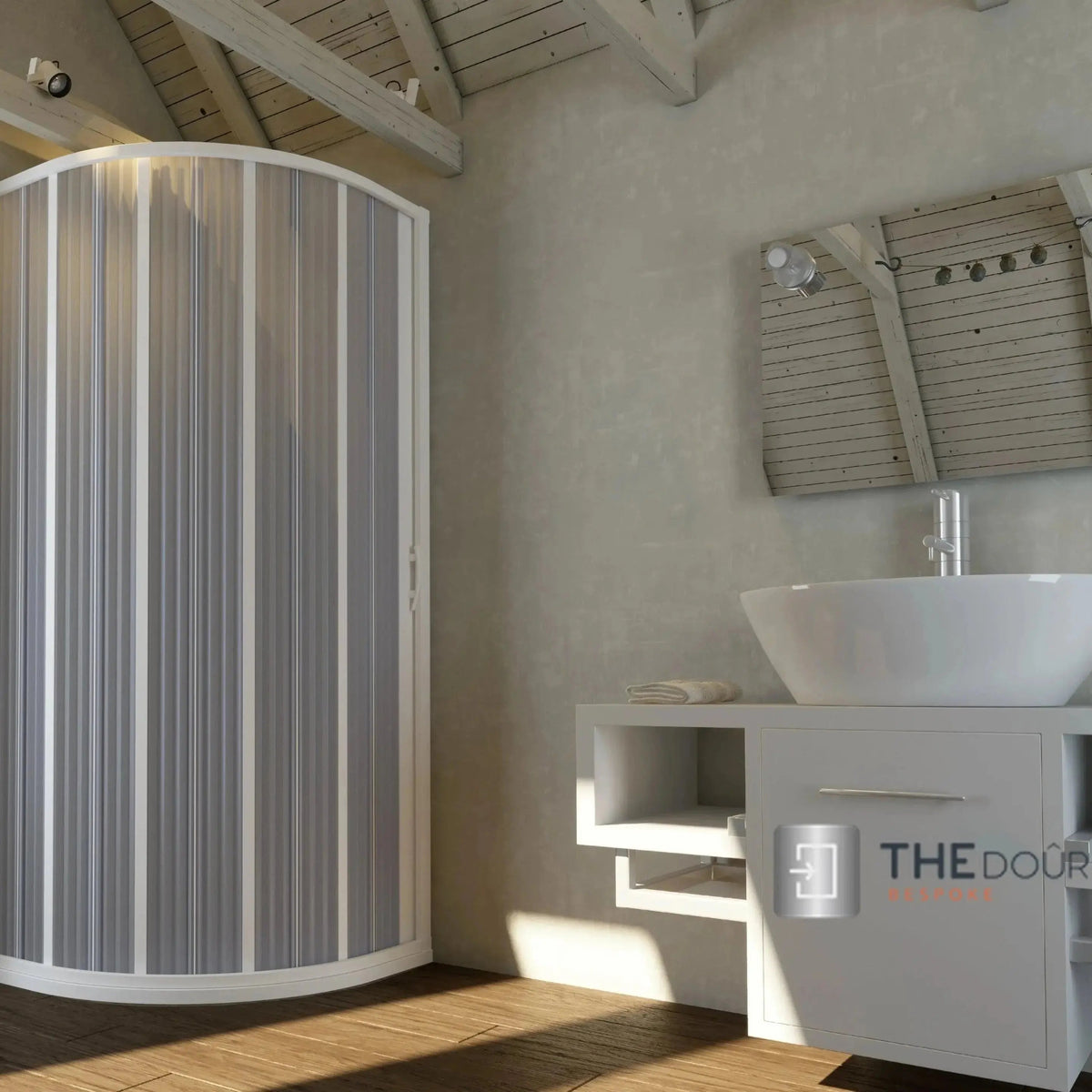
If you've ever stayed in a Tokyo apartment, you'll know the feeling: everything you need is there, but nothing is wasted. As a small family business in Pembrokeshire that spends every day thinking about tight spaces, I find Japanese homes fascinating. They've been solving the same problems our customers bring to us – small bathrooms, doors that eat up floor space, rooms that need to do three jobs – for a very long time.
So this week I want to share a few Japanese space-saving ideas that work just as well in a UK flat, a garden office or a tiny home, and how our doors and blinds can help you bring them home.
How small is a small Japanese apartment?
The typical single-person flat in Japan is a "1R" or "1K" – one room, sometimes with a separate little kitchen. According to Tokyo lettings specialists, these studios usually measure around 15–25 m², with many central Tokyo studios at roughly 20 m². That's the living room, bedroom, kitchen and bathroom combined, which is smaller than plenty of UK living rooms on their own.
What makes these flats work isn't magic. It's a handful of simple rules that are repeated in almost every home.
Lesson 1: Doors that slide, not swing
Traditional Japanese houses are built around sliding panels. Fusuma are opaque sliding partitions and shōji are the lighter paper-and-lattice screens that let soft light through. Both run along a rail, so there's no swing zone to keep clear, and fusuma can be lifted out altogether to turn two rooms into one.
A standard hinged door needs a clear arc of floor in front of it – floor you can't put a bed, a bin or a towel rail on. In a 20 m² flat, or a UK box room, that arc is valuable. Swapping hinged doors for sliding, folding or retractable ones is one of the quickest ways to win space back.
Where sliding or retractable doors help most
- En-suites and cloakroom toilets where a hinged door clashes with the basin or WC.
- Wardrobes and alcoves where swing doors block the bed or walkway.
- Utility cupboards and under-stair storage in narrow hallways.
- Home offices and garden rooms where you want to hide a desk or shelving at the end of the day.
Lesson 2: The bathroom is a compact, waterproof "unit"
One of Japan's great small-space inventions is the unit bath – a factory-made, all-in-one bathroom pod. TOTO, the Japanese bathroom maker, developed its first prefabricated bathrooms for the Hotel New Otani in Tokyo, which had to be built in a hurry ahead of the 1964 Tokyo Olympics. Bathrooms that once took weeks to build on site could be assembled in a day, and all 1,044 rooms were fitted in about three and a half months. TOTO says that by 2017 prefabricated bathrooms made up nearly 90% of the Japanese bathroom market, and you'll find a compact unit bath in many small studios today.
The idea behind it is worth copying even if you're not buying a pod: treat a small bathroom as one wet zone, keep everything easy to wipe down, and don't let the shower screen or door dictate the layout. A big swinging glass door is often the single biggest space thief in a small British bathroom.
Lesson 3: One room, many jobs
In a traditional Japanese home, futons are folded away into cupboards during the day so the same room can be used for living, eating and sleeping. Many modern flats keep that habit. The secret is good storage with doors that don't get in the way, and a way to change the feel of a room quickly – bright and open by day, dark and private at night.
That's where window coverings matter. Shōji screens soften light while blocking views; in a UK home the modern equivalent is a blind you can set to give privacy, then pull fully closed for proper blackout when the room becomes a bedroom.
How THEdoûr products help bring Japanese ideas home
We've spent years making doors, blinds and nets for campervans, where every centimetre counts – and the same products work brilliantly in small homes and offices.
- Space-saving doors: Our space-saving doors for home and office include the TAMdoûr tambour sliding door and the ROLdoûr retractable door, which roll or slide out of the way instead of swinging. They're ideal for wardrobes, cupboards and small en-suites – very much in the spirit of fusuma.
- Shower and bath doors with no swing: FLEXdoûr (zero-glass PVC, made in Italy) and FOLdoûr (bi-fold, zero-glass acrylic) fold neatly back, so you get a proper enclosure without a door swinging into a tiny bathroom. See our shower enclosure doors and bath enclosure doors.
- Blinds for multi-use rooms: WINdoûr insulated honeycomb blinds give blackout and help keep warmth in, with the DUO version adding a net, and the ROLdoûr Slimline retractable blind or net suits tighter frames. Browse our home and office blinds.
- Door screens instead of extra doors: NETdoûr pleated trackless nets and BLINDdoûr insulated blackout screens are made to measure from 1500–2000mm high and 600–2000mm wide, with a low-profile floor guide – handy for patio doors and room dividers. Find them on our door blinds and nets page.
Not sure what will fit? Our free Size My Door and Measure My Blind tools walk you through it, and our support guides cover fitting.
Quick checklist: Japanese-style small-space thinking
- Walk through each room and spot every door swing – could it slide, fold or roll instead?
- Treat a small bathroom as one wet zone and choose a shower or bath door that folds back.
- Give every "multi-use" room good storage so it can be cleared quickly.
- Choose blinds that do privacy by day and blackout by night.
- Measure carefully before you buy – made-to-measure always beats "nearly fits".
FAQs
What is a Japanese unit bath?
A unit bath is a prefabricated, all-in-one bathroom made in a factory and installed as a complete unit. TOTO developed early versions for Tokyo's Hotel New Otani before the 1964 Olympics, and they are now very common in Japanese homes, including small studio flats.
Are sliding doors really more space-saving than hinged doors?
Yes, in most small rooms. A hinged door needs a clear arc of floor to open, while sliding, tambour, folding and retractable doors stay within or close to the frame, so you can use the floor in front of them.
Can THEdoûr space-saving doors be used in a house rather than a campervan?
Absolutely. Our TAMdoûr, ROLdoûr, FLEXdoûr and FOLdoûr doors are used in homes, offices and retail spaces as well as vans. Have a look at our Home & Office range.
Which blind is best for a room that's a living room by day and a bedroom by night?
An insulated honeycomb blackout blind such as WINdoûr is a good choice, as it darkens the room fully and helps keep heat in. The DUO version adds a net for daytime privacy and airflow.
Bring a bit of Tokyo thinking into your home
You don't need a Tokyo postcode to live like a small-space expert. Start with the doors that get in your way, sort out the bathroom, and choose blinds that let one room do several jobs. If you'd like help working out what will fit, get in touch with our family team – we're always happy to talk through your space, wherever in the world you are.
– Rhys, THEdoûr Bespoke
Share:
Wintering in Spain and Portugal in Your Campervan: Mosquitoes, Heat and Privacy
Campervan Shower Room Layouts: 3 Walk-In, Walk-Out Ideas With Two Retractable Doors